When the tail becomes the baseline
The tail event risk teams were supposed to stress test once a decade is now resetting every few hours. A practitioner note on what that means for stress testing, DFAST overlays, and boardroom posture.
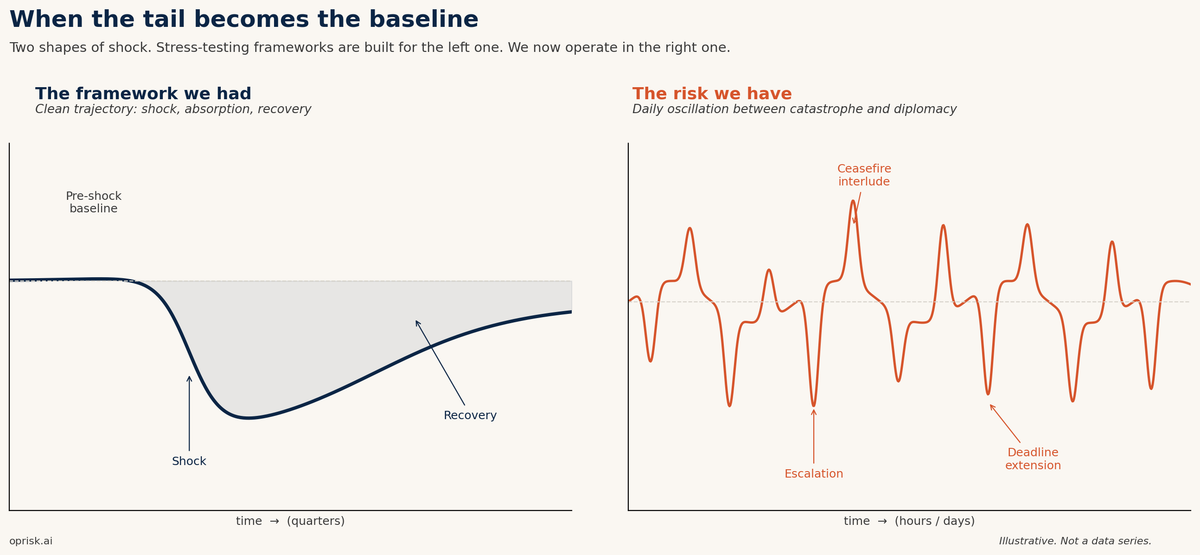
Operational risk frameworks were built for shocks with identifiable trajectories. The Gulf oil cycle of the last ten days has a different shape. It oscillates between catastrophe and diplomacy on a daily rhythm, and that oscillation is the risk.
The shock we modeled
Early in my career, I worked on identifying and quantifying the impact of supply-side oil shocks. A supply-side disruption was flagged as a tail event. Extreme, highly improbable, and in those years not especially urgent. Western reliance on Middle Eastern oil had been falling for a decade. Global energy markets had been calm long enough to feel structural. The standard framing placed an oil supply-side shock somewhere out at the 99.5th percentile of a stress test, described in careful qualitative language, never quite expected to arrive.
That tail is now the headline. And the headline changes by the hour.
Whiplash as the environment
This evening, President Trump announced a two-week ceasefire, hours after warning earlier in the day that a "whole civilization will die tonight." That statement followed at least three prior deadlines, each extended, each accompanied by escalating threats, and, almost simultaneously, proclamations that talks were going well.
For a risk professional, that whiplash is not background noise. It is the risk environment itself.
Our scenario libraries are built around identifiable trajectories. Pre-event, event, post-event. Shock, absorption, recovery. What we are operating in now has a different geometry. Escalation, then interlude. Threat, then ceasefire. Deadline, then extension. Each cycle lasting hours, not quarters. The second derivative matters more than the first.
Two balance sheets, one oscillation
US institutions. Oil has crossed $100 per barrel. Gas prices are up 39 percent since February. Inflation is now forecast above 3 percent, and the rate-cut path has been pushed further out. The DFAST macro overlay has effectively been repriced mid-cycle. A two-week pause does not unwind any of that. It just resets the clock to the next escalation window.
Gulf institutions. GCC oil output is down roughly 33 percent. GDP risk sits in a -10 to -15 percent range, depending on the assumed duration. QatarEnergy has warned it can no longer guarantee LNG deliveries. Third-party concentration risk crystallised overnight. Counterparty exposure, freight insurance, port access, and shipping routing all moved together. The Strait reopening is a negotiating interlude, not a resolution, and the market is pricing it that way.
These are two very different balance sheet pictures. They are responding to the same oscillation.
What the moment asks of risk leadership
The most valuable thing a risk executive can do this week is not run another model. It is walk into the boardroom with clarity on three things. What we assumed. Where reality has diverged from those assumptions. What our response posture is under continued oscillation.
Every other activity is downstream of that conversation.
A framework problem, not a data problem
Our frameworks were built for shocks with identifiable trajectories. This one oscillates between catastrophe and diplomacy on a daily cycle. That uncertainty is not a gap in our models. It is the risk.
The implication for how we stress test, how we design scenarios, and how we frame residual risk in board reporting is substantial. I will have more to say on that in the coming weeks. For now, the practical point is this. If your current operating assumption is that one of the extreme branches will resolve and the other will dissolve, you are planning for a shape of shock that this event does not have.
Closing note
Stay safe to everyone in the region.
If you are wrestling with how to frame this in your own institution's risk narrative, I would value the conversation. The email address is chitresh@oprisk.ai.